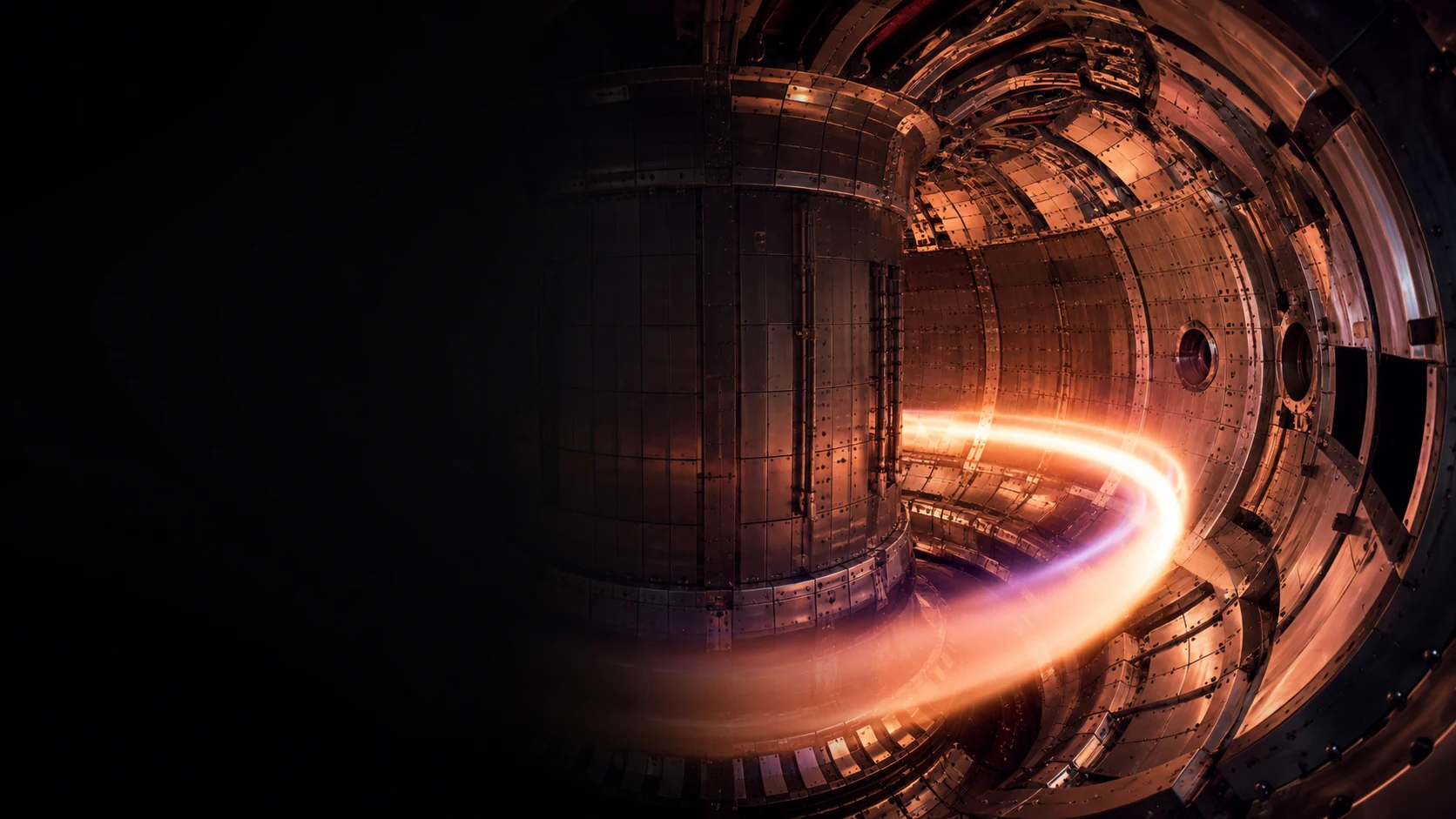
Operating-space decisions
Evaluate power balance, confinement, profiles, and uncertainty together to select candidate operating conditions.
PrimeRadiants Fusion · Sovereign physical intelligence · Available now
Connect reactor design, evolving plasma state, and bounded control in one sovereign physics engine. Optimize stellarator coils, assess stability, manage divertor heat, and choose the next shot—with local execution and independently replayable evidence.
For fusion developers, plasma-control teams, and reactor design programs.
Reactor intelligence · Local execution · Deterministic · Air-gap capable
Results for your engineering decisions
Keep the physics behind magnetic design, plasma performance, exhaust handling, and control decisions connected. Move from a saved scientific result to the next engineering action without losing its assumptions, sensitivities, or evidence.
Evaluate power balance, confinement, profiles, and uncertainty together to select candidate operating conditions.
Carry a saved three-dimensional equilibrium into non-planar coil optimization, retaining magnetic mismatch, engineering limits, and analytical sensitivities.
Connect growth rates, target heat, temperature, and detachment margin to actuator commands bounded by physical limits.
Rank candidate shots, compare risk and expected value, and retain the evidence before committing machine time.
Eight plasma inputs to 32 independently verified growth rates.
From observation to actuator command, including a 16-step forecast and checks on actuator limits.
Digital-twin control trial across 4,096 updates; action 420 seconds before the modeled event.
Reduction in the surface-integrated boundary-normal field objective on a 256-point plasma boundary.
What you can do today
Start with your reactor inputs and operating limits. Carry a saved equilibrium into coil design, or connect plasma-state assessment to a bounded control decision. Your engineering and operations teams can inspect and continue from the same scientific result.
Evaluate power balance, confinement, radial profiles, uncertainty, and operating envelopes.
Carry a saved three-dimensional equilibrium into non-planar coil optimization, then reopen the complete result without rerunning the solvers.
Connect target heat, temperature, detachment margin, and uncertainty to bounded actuator commands.
Evaluate stability and corrective actions in a telemetry-driven reactor twin with a replayable control record.
Screen campaign candidates against safety, value, and operating constraints before committing facility time.
Where the product fits
PrimeRadiants connects native scientific models to sovereign operational decisions. Fusion is the first commercial market; the same PRX architecture spans orbital systems, quantum hardware, electromagnetics, materials, and hypersonics.
| Capability | CAE / HPC physics | Learned physics models | Conventional control | PrimeRadiants PRX |
|---|---|---|---|---|
| Scientific basis | Numerical physics solvers | Trained model, often with physics constraints | Control laws and plant models | Native scientific execution |
| Time to action | Workload and solver dependent | Fast inference after training | Real-time control loops | Near-real-time qualified decision transactions |
| Training requirement | No model training required | Model training or fine-tuning | Usually no model training | No training required |
| Required inputs | Geometry, conditions, material models, calibration | Training inputs, validation, operating inputs | Telemetry, setpoints, plant parameters | Authoritative inputs required by the physics transaction |
| Data custody | Local, HPC, cloud, or hybrid | Local, edge, or cloud; model pipeline dependent | Typically on-device or local | Customer-controlled, air-gapped, no-egress capable |
| Design | Engineering analysis and optimization | Prediction and optimization within model coverage | Control-system design and tuning | Integrated scientific design workflows |
| Operations | Simulation and external operational integrations | Inference integrated into operating workflows | Monitoring and regulation of the target system | Integrated physics-to-decision workflows |
| Physical control | Controller integration or co-simulation | Controller integration and assurance | Core function | Bounded, physics-aware, fail-closed control |
| Replay | Solver and saved-state dependent | Model, version, and inputs dependent | Model and control-log dependent | Source-bound independent replay |
| Evidence | Solver outputs and workflow records | Model, dataset, and experiment records | Telemetry and event logs | Native transaction evidence and provenance |
| Deployment | Workstation, cluster, cloud, or HPC | GPU workstation, server, cloud, or edge | Desktop, embedded, or industrial hardware | Terminus Station appliance |
| Across domains | Solver and product-suite dependent | Model training or adaptation by domain | Plant- and application-specific | One reusable PRX architecture across physical domains |
Explore the approaches: CAE / HPCLearned physicsReal-time control
Fusion brings operating-space exploration, equilibrium-to-coil design, plasma-state prediction, and bounded control together through one GPU-native interface.
Differentiable tokamak transport modeling for pulse design, trajectory optimization, and controller development.
Connect transport-informed operating decisions to the wider plasma, divertor, control, and campaign workflow.
Read TORAX documentationThree-dimensional MHD equilibrium and stellarator optimization with automatic differentiation.
Carry equilibrium into non-planar coil design, then retain the inputs, constraints, and result for independent replay.
Read DESC documentationA modular framework for stellarator equilibrium, magnetic-field, and coil optimization.
Access packaged reactor and coil-design workflows with local GPU execution and a consistent engineering record.
Read SIMSOPT documentationBuilt for your engineering team
Run Fusion on Terminus Station and connect your reactor inputs, engineering tools, and operating limits. The evaluation package brings reactor design, plasma-state assessment, and bounded control together with saved results your team can independently replay.

Customer proof pack
45.47% lower magnetic-mismatch objective. Reopen the optimized coil design and independently verify the result without rerunning the optimization.
c9adf0d614c22ff45a4d75df09097936a5f23d76fa1729280e08ba6ba1acab4aInside the customer proof pack
Optimize a non-planar stellarator coil against a saved three-dimensional equilibrium. The customer receives the design, its scientific inputs, and executable evidence for technical diligence, design handoffs, and supplier acceptance.
From 0.1137483166 to 0.0620286842 T² m².
Observed execution time for the integrated coil-design case.
Magnitude of the analytical derivative duality residual.
Numerical consistency of the saved boundary result.
14 native corruption controls and 11 archive-rejection cases passed. CUDA memory validation recorded zero errors.
Independent replay loads the saved equilibrium and coil transaction directly, without rerunning optimization or source construction.
Work with us
Bring a reactor-design objective, plasma-control challenge, or campaign decision. Define the operating envelope and the result your team needs to demonstrate.